

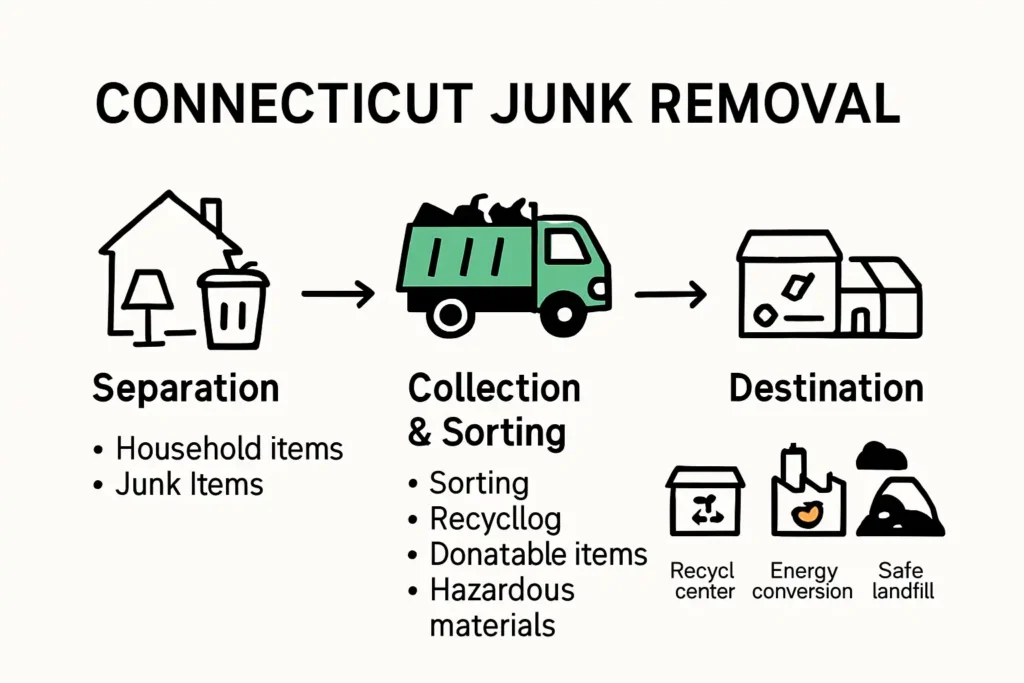
Every year, Connecticut residents say goodbye to mountains of junk—and over $7.5 million was just invested into new waste diversion programs in 2025. Most assume their old furniture, electronics, and clutter end up buried in a landfill or whisked away, never to be thought of again. Turns out, that junk often gets a surprising second life, turning from trash into valuable resources in ways that flip the script on what waste can actually do.
Table of Contents
- Understanding The Journey Of Your Junk
- Sorting, Recycling, And Responsible Disposal
- Special Handling For Hazardous And Large Items
- Emergency And Same-Day Junk Removal In Connecticut
Quick Summary
| Takeaway | Explanation |
|---|---|
| Junk removal begins with sorting. | Connecticut junk removal starts with careful categorization of materials into recyclables, donatables, and waste to optimize recycling and disposal processes. |
| Proper disposal of hazardous waste is essential. | Hazardous items require specialized handling to prevent environmental contamination, following strict regulations established by state authorities. |
| State mandates enhance recycling efforts. | Connecticut laws require recycling compliance from residents and businesses, promoting responsible waste management and minimizing landfill use. |
| Emergency removal services prioritize rapid response. | Emergency junk removal teams are strategically deployed for urgent needs, ensuring quick and environmentally sound waste management. |
| Reuse can turn junk into valuable resources. | Many discarded items, including furniture and construction materials, can be salvaged or repurposed, which benefits the environment and economy. |
Understanding the Journey of Your Junk
When you wave goodbye to your unwanted items during a junk removal service, the story of those materials is far from over. In Connecticut, waste management is a carefully orchestrated process that transforms discarded items from potential landfill waste into resourceful opportunities for recycling, repurposing, and environmental conservation.
The Initial Sorting Process
Immediately after removal, junk goes through a critical initial sorting phase. Explore our comprehensive waste management approach that ensures each item receives appropriate treatment. The Connecticut Department of Energy & Environmental Protection (DEEP) emphasizes a comprehensive materials management strategy that prioritizes waste reduction and strategic disposal. Professionals carefully separate materials into distinct categories: recyclables, donatable items, electronic waste, construction debris, and non-recyclable waste.
Different materials follow unique paths. Metals, plastics, paper, and glass are typically sent to specialized recycling facilities where they are cleaned, processed, and transformed into new products. Furniture in good condition might be directed to donation centers, while electronics require special handling due to potential hazardous components.
Environmental and Economic Implications
Connecticut’s waste management approach is more than just disposal it’s a comprehensive system designed to minimize environmental impact. According to the University of Connecticut’s Office of Sustainability, innovative initiatives are constantly emerging to convert waste into valuable resources. Food waste can be transformed into compost or energy, while construction materials might be crushed and reused in road construction or landscaping projects.
The state’s Solid Waste Management Services Act provides a legal framework that guides these processes, ensuring that junk removal is not just about clearing space but about responsible environmental stewardship. This approach creates economic opportunities by turning waste into raw materials for new industries, supporting local recycling centers, and reducing the burden on traditional landfill systems.
Understanding the journey of your junk reveals a complex, carefully managed process that extends far beyond simple disposal. Each item you discard represents a potential resource, carefully evaluated and processed to minimize waste and maximize environmental and economic benefits.
Sorting, Recycling, and Responsible Disposal
The journey of junk in Connecticut transforms waste from a potential environmental burden into a strategic resource through meticulous sorting, advanced recycling techniques, and responsible disposal practices. This comprehensive approach ensures minimal environmental impact while maximizing resource recovery and economic efficiency.
Advanced Material Categorization
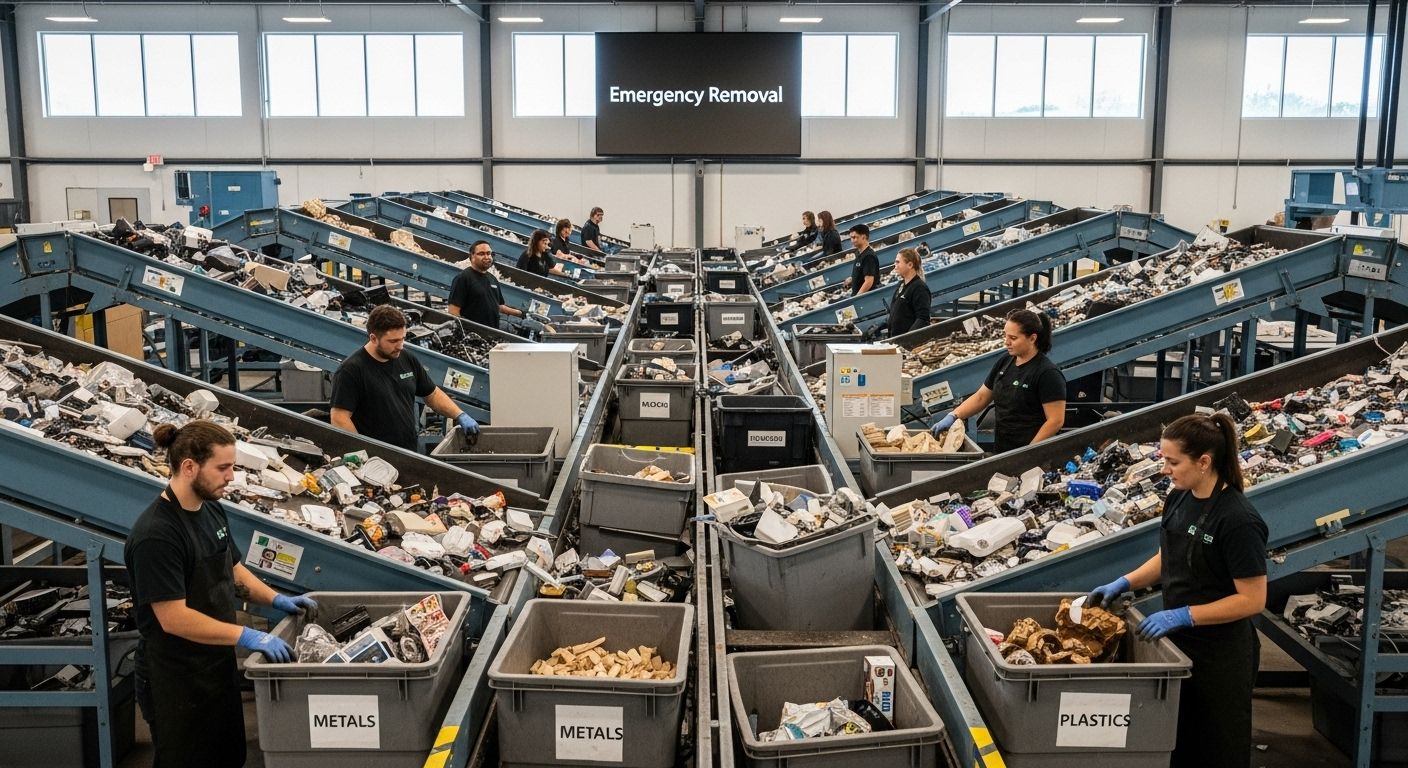
Professional waste management teams employ sophisticated sorting techniques that go beyond basic recycling. Learn more about our debris handling strategies that prioritize material recovery. According to the Western Connecticut Council of Governments, regional waste collaboration has significantly improved sorting precision. Materials are now categorized into granular classifications: high-grade recyclables, low-grade recyclables, compostable organic waste, electronic components, hazardous materials, and true landfill waste.
Metals like aluminum and steel are immediately separated for direct recycling, often melted and reprocessed within weeks. Plastics undergo complex sorting by polymer type, with some materials suitable for direct reuse and others requiring advanced processing. Wood products are evaluated for potential repurposing in construction, furniture manufacturing, or biomass energy production.
Here is a summary table outlining how different material categories are handled during the sorting process:
| Material Category | Typical Handling Method | Potential End Use |
|---|---|---|
| High-Grade Recyclables | Immediate separation and recycling | New manufactured goods |
| Low-Grade Recyclables | Advanced processing or downcycling | Packaging, composite materials |
| Compostable Organic Waste | Collection for composting or energy | Soil amendment, renewable energy |
| Electronic Components | Specialized sorting and handling | Recovered metals, refurbished parts |
| Hazardous Materials | Strict segregation and regulated disposal | Safe destruction, controlled recycling |
| True Landfill Waste | Final disposal at landfill | N/A |
Legal Framework and Mandatory Recycling
Connecticut’s waste management approach is underpinned by robust legal requirements. State regulations mandate comprehensive recycling protocols for all residents and businesses. The Connecticut Department of Energy & Environmental Protection recently allocated $7.5 million to municipal waste diversion programs, emphasizing food waste separation and innovative recycling techniques.
Multi-family dwellings, commercial establishments, and individual households must now adhere to strict waste separation guidelines. This legal framework ensures that recyclable materials are systematically diverted from landfills, reducing environmental strain and promoting a circular economy. Electronic waste, in particular, receives special attention due to potential environmental and health risks associated with improper disposal.
Responsible disposal is not just an environmental imperative but an economic opportunity. By transforming waste into valuable resources, Connecticut creates jobs, supports local recycling industries, and reduces long-term environmental management costs. Each ton of recycled material represents a step toward sustainable resource management, proving that what was once considered ‘junk’ can be a critical component of our economic and environmental future.
Special Handling for Hazardous and Large Items
Not all junk is created equal. In Connecticut, hazardous and oversized items require specialized disposal protocols that go far beyond standard waste management practices. Learn about our expert handling techniques to understand the intricate process of managing complex waste materials.
Hazardous Waste Management Protocols
Hazardous waste demands extraordinary care and precision. The Connecticut Department of Energy & Environmental Protection (DEEP) establishes rigorous guidelines that mandate specific handling procedures for materials that pose potential environmental or health risks. These regulations incorporate comprehensive federal standards, ensuring that substances like chemicals, electronic waste, batteries, and contaminated materials receive appropriate treatment.
Connecticut’s hazardous waste management approach includes detailed classification systems. Certain solvent-contaminated materials, for instance, may qualify for specialized exemptions under the EPA’s Solvent-Contaminated Wipes Rule, which provides nuanced guidelines for specific waste categories. Professionals undergo extensive training to identify, segregate, and process these complex materials, preventing potential environmental contamination.
Large Item and Organic Waste Disposal
Oversized items and organic materials require equally sophisticated disposal strategies. The state’s Commercial Organics Recycling Law provides explicit guidelines for managing large-scale organic waste. Universities generating more than twenty-six tons of organic materials annually must implement specialized collection and composting protocols, particularly if located within 20 miles of an authorized composting facility.
Large furniture, construction debris, and industrial equipment undergo meticulous assessment before disposal. Each item is evaluated for potential deconstruction, material recovery, or specialized recycling. Furniture might be disassembled to salvage reusable components, while industrial equipment could be stripped for valuable metals and electronic parts.
Below is a checklist table summarizing special handling requirements for hazardous and large items as described in this section:
| Item Type | Special Handling Required | Regulatory Guidance | Typical Disposal/Processing |
|---|---|---|---|
| Hazardous Chemicals | Yes | DEEP, Federal EPA Standards | Safe destruction/regulated recycling |
| Electronic Waste | Yes | DEEP, Electronic Waste Laws | Component salvage, metals recovery |
| Solvent-Contaminated Materials | Yes | EPA Solvent-Contaminated Wipes Rule, DEEP | Specialized exemption disposal |
| Batteries | Yes | DEEP, Federal Standards | Segregated recycling/disposal |
| Furniture (Large) | Yes | Assessed under State Recycling & Recovery Guidelines | Disassembly, reuse, donation |
| Construction Debris/Industrial Eq. | Yes | CT Solid Waste Laws/Ordinances | Material recovery, metal salvage |
| Commercial Organic Waste | Yes | CT Commercial Organics Recycling Law | Composting, energy production |
The complexity of special waste handling underscores Connecticut’s commitment to environmental stewardship. By implementing stringent protocols for hazardous and large items, the state transforms potentially dangerous waste into manageable, often recyclable resources. This approach not only protects public health and environmental integrity but also demonstrates a forward-thinking model of responsible waste management that balances safety, sustainability, and resource conservation.
Emergency and Same-Day Junk Removal in Connecticut
In the fast-paced landscape of Connecticut’s waste management, emergency and same-day junk removal services have become increasingly critical for residents and businesses facing urgent disposal needs. Explore our comprehensive emergency removal strategies that address immediate waste management challenges with precision and efficiency.
Rapid Response Protocols
Emergency junk removal requires a sophisticated, multi-layered approach that goes beyond traditional waste management. The Connecticut Department of Energy and Environmental Protection (DEEP) recognizes the importance of swift waste diversion, particularly in scenarios involving property cleanouts, disaster recovery, or sudden large-scale disposal requirements. These situations demand immediate action to prevent environmental contamination and potential health risks.
Professional teams are strategically positioned across Connecticut to provide immediate response. Whether triggered by estate cleanouts, foreclosure situations, natural disaster aftermath, or unexpected large-item disposal, these services ensure rapid removal while maintaining strict adherence to state recycling and disposal guidelines. Specialized vehicles and trained personnel can be dispatched within hours, minimizing disruption and potential environmental impact.
Sustainable Emergency Disposal Strategies
Even in emergency scenarios, Connecticut maintains a commitment to sustainable waste management. The U.S. Environmental Protection Agency’s national recycling guidelines emphasize the importance of responsible disposal, a principle that remains paramount during urgent removal operations. Emergency junk removal teams are equipped with advanced sorting capabilities, enabling immediate categorization of materials for recycling, donation, or specialized disposal.
Connecticut’s recycling programs prioritize diverting materials from landfills, even in time-sensitive situations. Electronics, metals, furniture, and construction debris are quickly assessed and routed to appropriate recycling or donation channels. This approach ensures that emergency removals do not compromise the state’s environmental conservation goals. Complex items like electronic waste receive special attention, with teams trained to handle potentially hazardous materials safely and efficiently.
The evolution of emergency junk removal reflects Connecticut’s forward-thinking approach to waste management. By combining rapid response capabilities with rigorous environmental standards, these services transform urgent disposal needs into opportunities for responsible resource management. Whether facing a sudden property clearance, dealing with storm debris, or managing unexpected large-item disposal, residents and businesses can rely on a system designed to act quickly while preserving environmental integrity.
Ultimately, emergency and same-day junk removal in Connecticut represents more than just fast waste elimination. It embodies a comprehensive strategy that balances immediate practical needs with long-term environmental sustainability, demonstrating the state’s commitment to intelligent, responsive waste management solutions.
Frequently Asked Questions
What happens to my junk after it is removed in Connecticut?
After removal, your junk goes through a sorting process where items are categorized into recyclables, donatables, and waste. Recyclable materials are sent to recycling facilities, while usable items may be donated.
How does Connecticut ensure proper disposal of hazardous materials?
Connecticut has strict regulations for hazardous waste management that require specialized handling to prevent environmental contamination. This includes specific guidelines established by the Connecticut Department of Energy & Environmental Protection (DEEP).
What laws are in place regarding recycling in Connecticut?
Connecticut mandates comprehensive recycling protocols for residents and businesses, aimed at reducing landfill waste and promoting responsible waste management. Recent investments have focused on enhancing these recycling and waste diversion efforts.
Are there emergency junk removal services available in Connecticut?
Yes, Connecticut offers emergency and same-day junk removal services. These services prioritize rapid response while ensuring that items are sorted for recycling or proper disposal, even in urgent situations.
Give Your Junk a Second Life with Hassle-Free Local Removal
Did you know that your discarded items could be recycled, donated, or repurposed rather than ending up in a landfill? The article highlights how responsible junk removal in Connecticut ensures your old furniture, electronics, and clutter are carefully sorted and directed to the right facilities. Still, navigating legal guidelines, hazardous waste concerns, and rapid response needs can feel overwhelming for most homeowners and businesses.
No need to stress over what happens after your junk leaves your doorstep. CM Carting Solutions specializes in eco-friendly junk removal for Litchfield County and nearby Connecticut communities. From sorting and recycling to safe disposal of hazardous waste, our team turns headaches into peace of mind. Want clear pricing and a smooth experience from start to finish? Request an online quote today and let our trusted, family-owned crew handle everything. Do not wait—declutter your space and do your part for the environment with a single click at https://cmcartingsolutions.com/get-a-quote/.
Recommended
- Junk Removal Process for CT Homes & Businesses 2025
- Junk Hauling Services Explained: What Connecticut Clients Need (2025) – C&M Carting Solutions
- Local Trash vs Junk Removal: A 2025 Guide for Connecticut – C&M Carting Solutions
- Garage Junk Removal Tips for Connecticut Homes 2025 – C&M Carting Solutions